CHAPTER 31/ 45
Financial Model Validation
Main thread: trace the information used by every label and feature through time. Purging removes overlapping label intervals; embargo removes specified post-test feature look-backs; a causal walk-forward protocol evaluates predictions using information available at deployment time. These controls address their declared channels and do not by themselves establish that an entire research pipeline is free of leakage. Prerequisites: Chapters 7, 16, 22, 29, and 30. You will derive half-open interval overlap, calculate removal and retention sets, diagnose row-count gaps in panels, implement purged splits and nested selection, and interpret constructed and historical industry-return comparisons.
1. Chapter Objectives
A subtle source of apparent generalization is the interaction between a forward-return label and a validation boundary. When the target is a five-day return, training features may all precede the test block while their labels still include returns realized inside it. A chronological split of feature rows alone does not resolve that problem.
After this chapter you should be able to:
-
Derive the overlap condition for
, and explain why touching endpoints do not overlap. Calculate the purge set for horizon
, establish the single-asset equivalence to gap=h-1on a regular observation calendar, and derive the residualoverlapping rows in the specified balanced panel. -
Distinguish the economic roles and directions of purge and embargo. Purge checks label intersections on both sides of a test block; embargo checks later training features whose historical support reaches back into the test span. Distinguish offline purged K-fold stability diagnostics from deployment-time walk-forward evaluation.
-
Use
src/quant_course/validation.pyto construct single-asset and panel splits, rolling and expanding windows, and nested selection. Fit the scaler and each candidate model only on the current inner training fold; select hyperparameters using inner validation scores. Refit on the current outer training set after selection, and use the outer test set only for evaluation. -
Check invalid intervals, touching endpoints, irregular calendars, multiple assets per date, and labels whose availability
is later than settlement . Interpret numerical differences under the actual constructed or French-industry protocol.
Completion means calculating the 15-observation example by hand and reconciling it with the code:
Then follow the default I3 reader route in §9 and complete the questions and answers. The stored five-seed and historical French results are inherited evidence. This revision does not rerun the full CLI, Notebook, runner, or historical studies. Correct splits alone do not validate every input, execution, or feature channel.
2. Why Quants Need It
Validation connects feature engineering to portfolio construction, the Chapter 29 execution ledger, and Chapter 32 performance inference:
Data/features --> Validation and information-aware splits --> Portfolio targets
  (Ch 3,23–28)                 (Ch 31)                       (Ch 20–21)
    --> Ledger reconciliation (Ch 29) --> Performance inference (Ch 32)
Under genuinely IID sampling, a declared target distribution and training size, and no continued model selection using outer results, random K-fold can estimate the predictive risk of the corresponding training procedure. That does not make it an unconditional unbiased estimate of future deployment risk. Financial data present several additional issues:
- Overlapping labels. In the additive approximation
, adjacent labels share four realized returns. The compounded definition appears in §4.1. Both definitions require tracking the interval ; random row allocation may place the same future realized return in both training and test labels. - Feature look-back leakage. Moving averages, momentum, and smoothing use historical observations. When a K-fold split trains on dates after a historical test block, those later training features can reach back into that test period.
- Global preprocessing. Fitting
StandardScaleror PCA before splitting exposes the training procedure to test means, variances, or other distributional information. - Rows versus dates.
TimeSeriesSplit(gap=...)removes rows. With many securities on each date, four removed rows need not cover even one complete trading date.
This chapter formalizes the timing diagnosis in Chapter 30. The resulting out-of-sample candidate sequences feed the multiple-testing methods in Chapter 32, including PBO and CSCV, subject to those methods' own assumptions.
3. Intuition
3.1 Why the Last Training Labels Already Contain Test Returns
Suppose features are formed at each daily close and predict the next five trading days. Assign observations
- The observation at close 4 predicts the return from close 4 to close 9.
- The first test observation at close 5 predicts the return from close 5 to close 10; the next predicts close 6 to close 11.
- More precisely, the training label at 4 contains
, while the test label at 5 contains . They share four periods, . At close 5, has already been realized, while the training label remains unsettled until 9. Calling all five returns future test returns would be inaccurate.
Treat each sample as an information interval, rather than a point on a row index.
3.2 The Frozen 15-Observation Example, Step by Step
Use observation starts
with daily returns
Test start 6: (6,11] contains returns 7,8,9,10,11.
Test start 7: (7,12] contains returns 8,9,10,11,12.
Test start 8: (8,13] contains returns 9,10,11,12,13.
The test-label span runs from start 6 to latest end 13.
First inspect the candidates before the test block:
- At 0, compare
with : is not less than . Retain 0. - At 1,
contains , while contains . They touch at the close-6 base price but share no return increment. The overlap test gives , which is false. Retain 1. - At 2,
. Return is shared. Remove 2. - At 3,
. Remove 3. - At 4,
. Remove 4. - At 5,
. Remove 5.
Thus the pre-test removal set is
Next inspect the candidates after the test block, comparing with the final test label
- At 9,
overlaps because . Remove 9. - At 10,
overlaps because . Remove 10. - At 11,
overlaps because . Remove 11. - At 12,
overlaps because . Remove 12. - At 13,
only touches : is false. Retain 13 at this stage. - At 14,
does not overlap because is false. Retain 14 at this stage.
After purge, the retained set is
Finally impose the declared feature embargo. Here the feature uses three past return periods, involving four prices: at 13 it uses prices on
Starts 13 and 14 lie inside that band and are removed. The final training set is
3.3 Reconcile the Removal and Retention Ledgers
The complete one-way filtering chain is
There are
Two touching cases illustrate the distinction.
If a prediction is made at time 6 and label 1 settles at
4. Mathematical Foundations
4.1 Observation Coordinates and Trading Calendars
Let
For a common date sequence
Writing the horizon as
4.2 Interval Algebra
For nondegenerate half-open intervals
where the intersection is empty if its lower endpoint is at least its upper endpoint. Hence
When
5. Formal Definitions
Observation time
Label end time ValueError for
Availability time validation.py interface accepts only
Candidate set
Purging. Define the removal set and then its complement:
One overlap with any test label is sufficient for removal. No overlap, including mere touching, passes this filter. Here
Embargo. Inspect only post-test candidates that have already passed purge:
Here
The filtering invariant is
A removed sample never reappears during embargo or later concatenation. A past-only walk-forward has no post-test candidates and thus
we already have
TimeSeriesSplit gap
Purged walk-forward. A forward-moving design with historical training candidates and a subsequent test block; check the trailing training labels for overlap.
Purged K-fold. Split time into
Nested validation. The outer split evaluates out-of-sample performance. Inner splits are confined to the current outer training set and select hyperparameters or features. Fit preprocessing means and variances only on the current training fold.
6. Derivations
6.1 Proof of the Necessary and Sufficient Overlap Condition
Theorem 1. For
Proof. Membership in the intersection requires both
Such a real
6.2 Purge Counts and Gap Equivalence for One Regular Asset
Assume fixed integer horizon
For a prior candidate
The integer starts to remove are therefore
whose count is
This count presumes those preceding observations exist. TimeSeriesSplit uses the exclusive slice end
For one regular asset, gap=h-1 sets that end to
6.3 Why the Same Row Gap Fails in a Panel
Theorem 2. Suppose a complete balanced panel has exactly (date, asset), fixed integer horizon
overlapping training rows.
Proof. Every asset on dates
The row-based algorithm instead removes only
a total of
For the frozen
7. Financial Interpretation
7.1 Why Do Financial Features and Labels Have Long Memory?
In classical statistics, residuals are often assumed to be independent and identically distributed white noise. Financial asset prices, however, are jointly driven by fundamentals, macroeconomic liquidity, and strategic interactions among investors.
If compounding period-by-period simple returns is approximated by summing small returns, an
This is an exact result for additive labels; the covariance is zero when
For the compounded simple-return label in §4.1,
If
The effect of label overlap on model evaluation depends on the data-generating process, model, feature structure, and test window. In this chapter's Ridge construction, the average score difference before and after purging is small across five seeds; this result alone does not characterize low-capacity models in general. A separate 1-NN construction illustrates how an unpurged boundary sample can provide a path for memorizing information shared with a test label. The size of that effect is not determined by model capacity alone and must be examined under the specific data and split.
7.2 How to Choose Between Purged K-Fold and Walk-Forward
Quantitative teams often debate whether model validation should use strictly forward Walk-Forward or whether Purged K-Fold, which trains on both sides of a test block, is acceptable. These approaches answer different scientific questions:
- Purged Walk-Forward answers the deployment question.
- It follows the one-way causal direction of time. At every prediction point, the model can use only past history.
- It can reflect how regime shifts, structural breaks, and distribution drift affect a strategy. Deployment evaluation should use a forward protocol whose inputs were available at the time. Passing the split does not establish that the real inputs, trading costs, or other channels are permissible.
- Purged K-Fold answers the cross-regime parameter-stability question.
- After removing overlapping labels with Purge and preventing feature lookback from crossing the test block with Embargo, it allows future data to train a model evaluated on a historical interval.
- It asks: “If an economic relationship holds in 2024, are its parameters stable in 2018?” By using more of the sample, it can test whether the model overfits a particular historical period. However, its test score cannot replace a deployment test along the real-time axis.
8. Numerical Example
This section fully reproduces and works through the frozen example from §3.2, then checks each step against the standardized results exported by the CLI.
9. Python Implementation
By default, walk_forward_splits uses purge_overlap=True and requires both observation times t and label end times e, each with the same number of entries as the samples. If either is missing, it raises an error rather than silently falling back to an ordinary time split. For a comparison experiment, Purge can be explicitly disabled with purge_overlap=False, but time order alone does not guarantee that labels have settled. For example, with n=15, train_size=6, test_size=3 and e=t+5, the first fold has candidate training samples 0–5 and test samples 6–8; after purging, only training samples 0 and 1 remain. Omitting the intervals would leave overlapping labels for training samples 2–5.
The chapter's core algorithm is in src/quant_course/validation.py. From the root of the accepted I3 reader package, the default command is:
python run_notebook.py notebooks/ch31_model_validation.ipynb
The default Notebook computes a new single-seed run for the four schemes on 500 dates, 1-NN, purged K-Fold, and nested construction; it does not merely read the five-seed summary. The French branch is skipped by default. The Notebook creates a unique runs/ch31_model_validation_<uuid>/ directory and writes figures there. The runner separately saves an execution copy and execution.json under runs/execution_<stem>_<uuid>/; failed runs are retained as well. Neither was executed for this revision. Full assembly and cold-start verification of the English Notebook and shared runner remain for BIL23. The following code is an entry point for reading the implementation and for a small independent example. It does not direct the reader to overwrite historical CLI defaults.
9.1 Interval-Overlap Test and Basic Purge / Embargo Functions
The following code shows how to implement vectorized overlap checks and filtering efficiently in NumPy, without loops:
import numpy as np
from quant_course.validation import check_label_intervals, intervals_overlap, purge, embargo

# Construct the hand-worked example with 15 observations
t = np.arange(15, dtype=float)
e = t + 5.0
test_idx = np.array([6, 7, 8])
cand_train = np.array([0, 1, 2, 3, 4, 5, 9, 10, 11, 12, 13, 14])

# 1. Apply Purge
purged_train = purge(cand_train, test_idx, t, e)
assert np.array_equal(purged_train, [0, 1, 13, 14])

# 2. Assert that endpoint touching is not overlap: sample 1 (1, 6] and test sample 6 (6, 11]
assert not intervals_overlap(t[1], e[1], t[6], e[6])

# 3. Apply Embargo (m = 3)
final_train = embargo(purged_train, test_idx, t, e, m=3)
assert np.array_equal(final_train, [0, 1])
print("Hand-worked Python Purge assertions passed; final training set:", final_train.tolist())
9.2 Causal Walk-Forward and Purged K-Fold Generators
import numpy as np
from quant_course.validation import walk_forward_splits, purged_kfold_splits

# 1. Expanding causal Walk-Forward
n_samples = 30
t_series = np.arange(n_samples, dtype=float)
e_series = t_series + 3.0  # 3-day forward return

splits_wf = walk_forward_splits(
    n_samples=30,
    train_size=10,
    test_size=5,
    step=5,
    expanding=True,
    t=t_series,
    e=e_series,
    purge_overlap=True,
)
print(f"Number of Walk-Forward folds: {len(splits_wf)}")
# First fold: test [10..14], candidate training [0..9], overlapping samples 8 and 9, retain [0..7]
train0, test0 = splits_wf[0]
assert np.array_equal(test0, np.arange(10, 15))
assert np.array_equal(train0, np.arange(8))

# 2. Date-grouped Purged K-Fold for panel data
dates_panel = np.repeat(np.arange(20), 2)  # 20 dates, 2 assets per date, 40 samples total
e_panel = dates_panel + 2.0
splits_pkf = purged_kfold_splits(
    n_samples=40,
    n_splits=4,
    t=dates_panel,
    e=e_panel,
    embargo_m=1,
    groups_date=dates_panel,
)
print(f"Number of Purged K-Fold folds: {len(splits_pkf)}")
train_f0, test_f0 = splits_pkf[0]
print(f"Rows in test fold 0: {len(test_f0)}, rows in retained training set: {len(train_f0)}")
9.3 Nested Hyperparameter Selection with Purge in Both Outer and Inner Folds
The example explicitly uses a forward-array convention: period_returns[i] is the synthetic return realized after feature time
import numpy as np
from sklearn.linear_model import Ridge
from quant_course.validation import nested_hyperparameter_evaluation

rng = np.random.RandomState(42)
N = 120
X_all = rng.randn(N + 1, 2)
X = X_all[:-1]
# period_returns[i] is realized over (i, i+1], driven by X_all[i] known at i.
period_returns = 0.5 * X_all[:, 0] + rng.randn(N + 1) * 0.1
# Two-period forward additive-return approximation.
y = period_returns[:-1] + period_returns[1:]
t_obs = np.arange(N, dtype=float)
e_obs = t_obs + 2.0
a_obs = e_obs.copy()  # This example assumes labels are available when their intervals end.

candidate_outer_splits = [
    (np.arange(60), np.arange(60, 90)),
    (np.arange(90), np.arange(90, 120)),
]
outer_splits = []
for train_idx, test_idx in candidate_outer_splits:
    prediction_time = np.min(t_obs[test_idx])
    eligible_train = train_idx[a_obs[train_idx] <= prediction_time]
    outer_splits.append((eligible_train, test_idx))

def inner_split_fn(out_tr, t_arr, e_arr):
    n = len(out_tr)
    folds = []
    for start, stop in [(n // 3, 2 * n // 3), (2 * n // 3, n)]:
        in_train = np.arange(start)
        in_val = np.arange(start, stop)
        prediction_time = np.min(t_arr[out_tr[in_val]])
        # The caller filters availability; the helper applies interval Purge.
        in_train = in_train[a_obs[out_tr[in_train]] <= prediction_time]
        folds.append((in_train, in_val))
    return folds

param_grid = [{"alpha": 0.01}, {"alpha": 1.0}, {"alpha": 100.0}]

def model_factory(p):
    return Ridge(alpha=p["alpha"])

def scorer(m, X_te, y_te):
    return -float(np.mean((m.predict(X_te) - y_te) ** 2))

nested_res = nested_hyperparameter_evaluation(
    X, y, t_obs, e_obs, outer_splits, inner_split_fn, param_grid, model_factory, scorer, scale_features=True
)
print("Nested selection outer-fold test scores:", nested_res["outer_scores"])
print("Best parameter selected in each outer fold:", nested_res["best_params_per_fold"])
print("Outer train/test indices actually used:", nested_res["outer_splits_used"])
print("Inner train/validation indices actually used:", nested_res["inner_splits_used"])
The helper applies label-interval Purge separately to the outer training candidates and each inner training set, and records the global indices actually used. In the pure forward example, the caller first filters labels by
The chapter CLI's synthetic study on 20 assets reported the following results, independent of the short structural example above (key: nested_selection):
- Honest outer-test mean MSE:
(key: nested_selection.mean_nested_outer_mse). - Test-set-tuned, or “cheating,” MSE:
(key: nested_selection.mean_naive_cheating_mse). - Difference:
(about 0.25%).
Why the difference is small: In this synthetic study, the candidate hyperparameter grid contained five
10. Visualization
The chapter's code/ch31_model_validation.py generated four high-resolution figures in figures/a6/, each corresponding to the derivations and numerical experiments in the text.
10.1 Label Intervals for the Worked Example
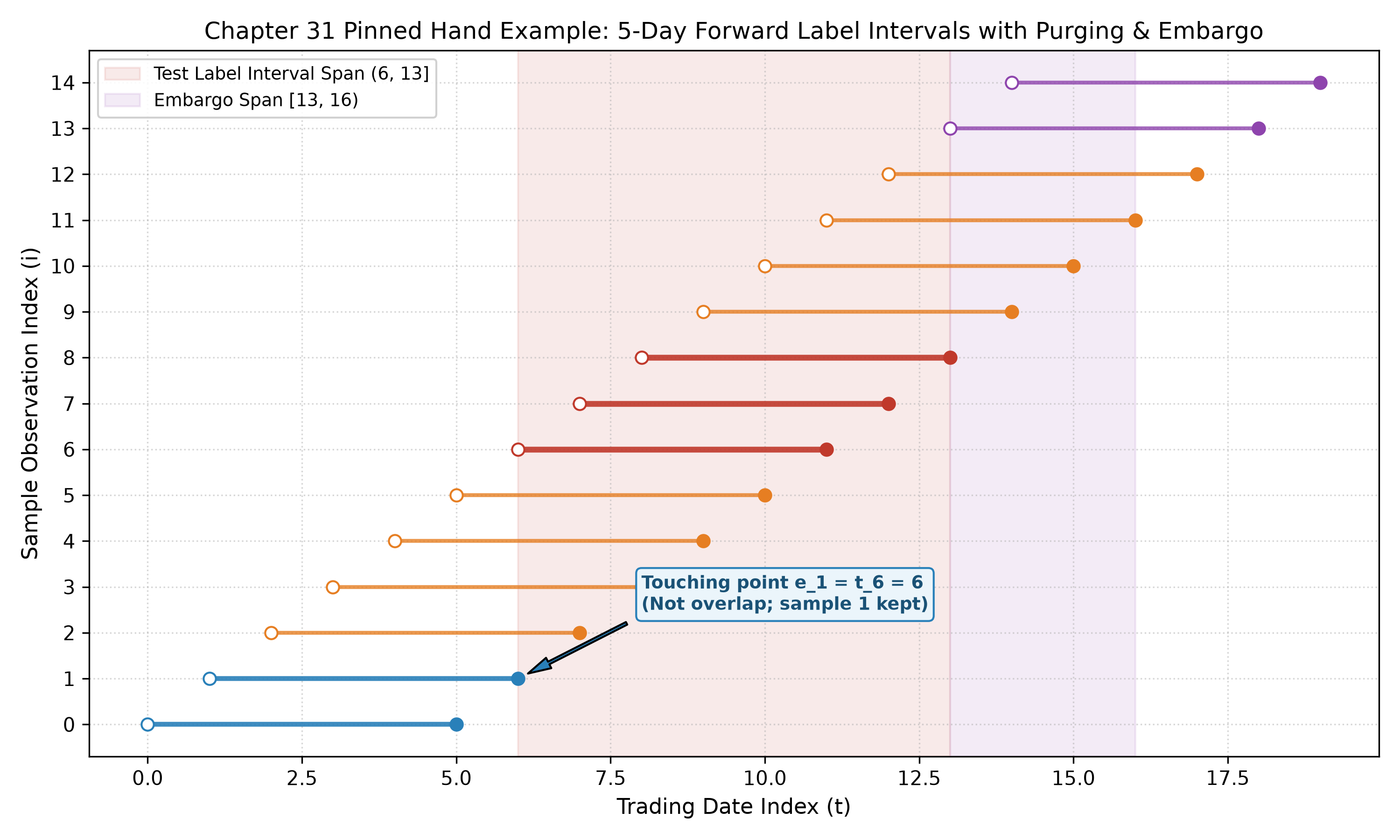
- File path: figures/a6/ch31_hand_label_intervals.png.
- Axes and units: The horizontal axis is the shared observation position
(a discrete integer extending through the final label endpoint, 19; 15 label starts do not mean the labels end at 14). The vertical axis is the sample observation index (integer, 0 to 14). - Samples and marks: All 15 half-open return intervals
are shown. Left endpoints are hollow circles and right endpoints are filled circles. Test-block samples are thick dark-red lines; samples removed by Purge for overlapping labels are orange; samples removed by Embargo for feature lookback penetration are purple; and the final clean training samples are thick dark-blue lines. - What to look for:
- The filled right endpoint of sample 1's label interval
coincides exactly at with the hollow left endpoint of test sample 6's interval . An arrow labels this “Endpoint touch, not overlap (touching point ,” showing why sample 1 is safely retained. - The label interval for post-test sample
does not overlap the test block, but it falls inside the purple embargo span , showing how Embargo protects against feature lookback.
- The filled right endpoint of sample 1's label interval
10.2 Leakage Ablation Comparison and Breakdown
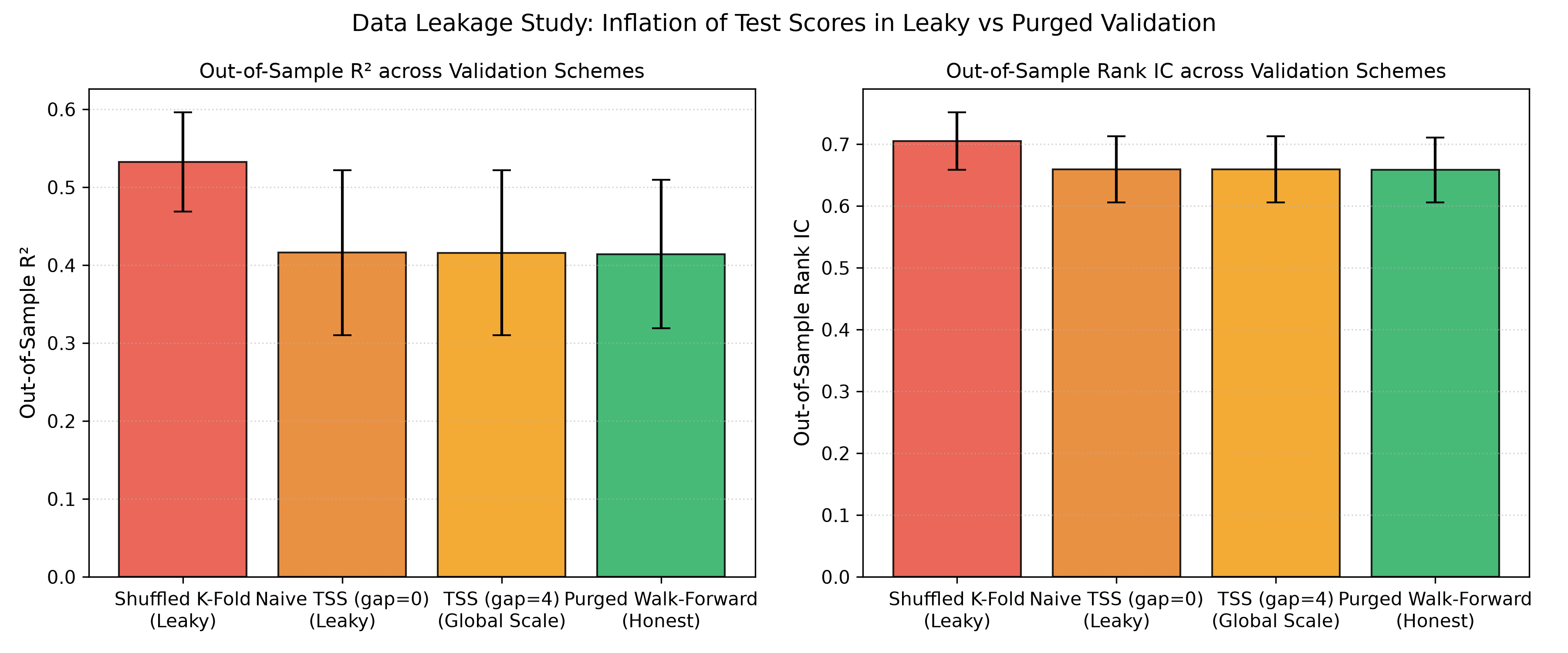
- File path: figures/a6/ch31_leakage_comparison.png.
- Axes and units: The left panel shows out-of-sample coefficient of determination
(dimensionless); the right panel shows out-of-sample rank correlation, Rank IC (dimensionless). The horizontal axis compares four validation schemes. Error bars show the standard deviation across five random seeds ([20261031, 20261032, 20261033, 20261034, 20261035]).
The table reports the observed five-seed mean values (key: leakage_experiment.schemes):
| Validation scheme | Out-of-sample |
Out-of-sample Rank IC (mean |
Out-of-sample MSE | Leakage and isolation properties |
|---|---|---|---|---|
| 1. Shuffled K-Fold | Time shuffled; globally normalized features | |||
| 2. Naive TSS (gap=0) | Not shuffled; no Purge; globally normalized features | |||
| 3. TSS (gap=4) | Not shuffled; four rows removed; global normalization | |||
| 4. Purged Walk-Forward | Strictly time-causal; Purge applied; training-set normalization |
- What the comparison shows:
- Observed differences between protocols: The saved mean
difference between Shuffled K-Fold and Purged Walk-Forward is 0.1184 (the Rank IC difference is 0.0471). The gap between the first two schemes is 0.1167, while the gap between the latter two protocols is about 0.0017. These are not matched ablations: Shuffled K-Fold and TSS use different training dates and sample sizes, while TSS and Purged Walk-Forward also differ in date grouping, Purge, and scaling range. The value 0.1167/0.1184, or about 98.6%, cannot be called a causal share attributable to shuffling; nor can 0.0017 be attributed to Purge alone. Identifying the contribution of any one change requires matching the training samples, test samples, preprocessing, and other conditions. - Boundary effects in the current linear-model comparison: In this Ridge construction with 20 assets, 500 days, and five seeds, the four-day label overlap at the boundaries of five large test blocks (80 days each) accounts for less than 2% of the training samples. The observed scores before and after purging are close. This describes the current design only; it does not show that low-capacity models are generally unaffected by leakage or that leakage effects occur only in high-capacity models or particular features.
- Unpurged inflation with a high-capacity memorization model (1-NN): To illustrate how label overlap can affect a high-capacity memorization model, a 1-nearest-neighbor (1-NN) model was evaluated in daily forward steps on a 30-asset panel (key: overlap_memorization_experiment).
- The unpurged 1-NN model had a mean out-of-sample Rank IC of
(the five seeds were , , , , and ). - The causal Purged result had a mean Rank IC of
(the five seeds were , , , , and ). These are observations under this data-generating process and a finite set of seeds, not a guarantee about true population predictive power. - In this construction, the unpurged model can match a test asset to its own unpurged sample from the previous day; the two labels share 80% of their returns. The five-seed mean Rank IC difference is
(key: overlap_memorization_experiment.rank_ic_inflation). This shows how some highly memorizing models may exploit label overlap. Together with the Ridge result, it does not establish a general monotonic relationship between model capacity and leakage bias.
- The unpurged 1-NN model had a mean out-of-sample Rank IC of
- Observed differences between protocols: The saved mean
10.3 Comparison of Row-Count gap with Interval Purge
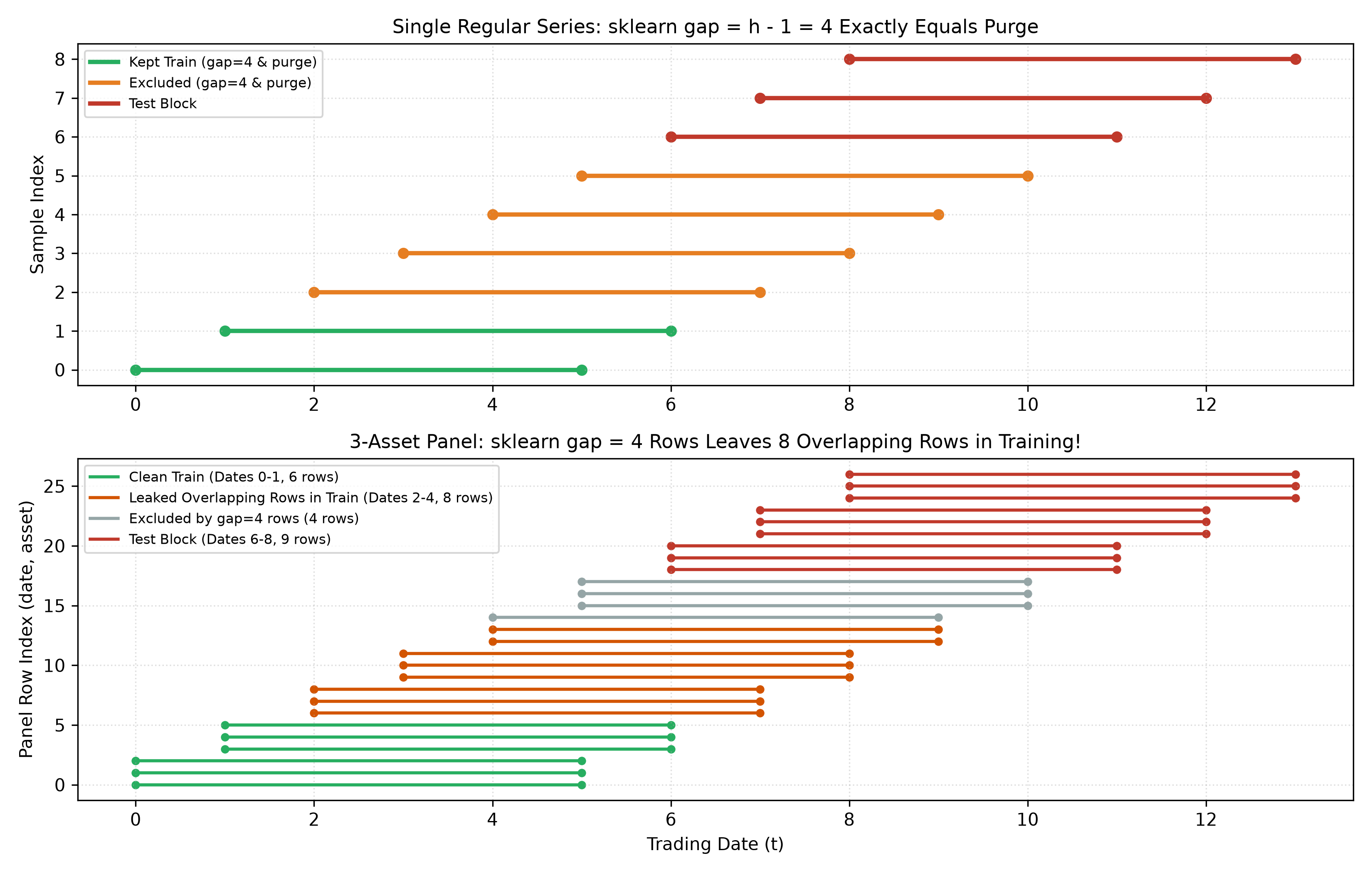
- File path: figures/a6/ch31_gap_vs_purge_panel.png.
- Axes and units: The upper panel shows a single-asset sequence (sample indices 0–8); the lower panel shows a three-asset panel (row indices 0–26, ordered by (date, asset)). Both horizontal axes show trading-day index
. - What to look for:
- In the single-asset sequence, gap=4 removes samples 2, 3, 4, and 5, exactly matching Purge row by row.
- The panel-data plot shows the substantial residual overlap: gap=4 removes only rows 14–17 (gray), while rows 6–13 (dark orange, covering eight rows across dates 2, 3, and 4) remain exposed in the training set, visually confirming Theorem 2.
10.4 Mean-Summary Plot for Rolling Validation on Real Monthly Industry Returns
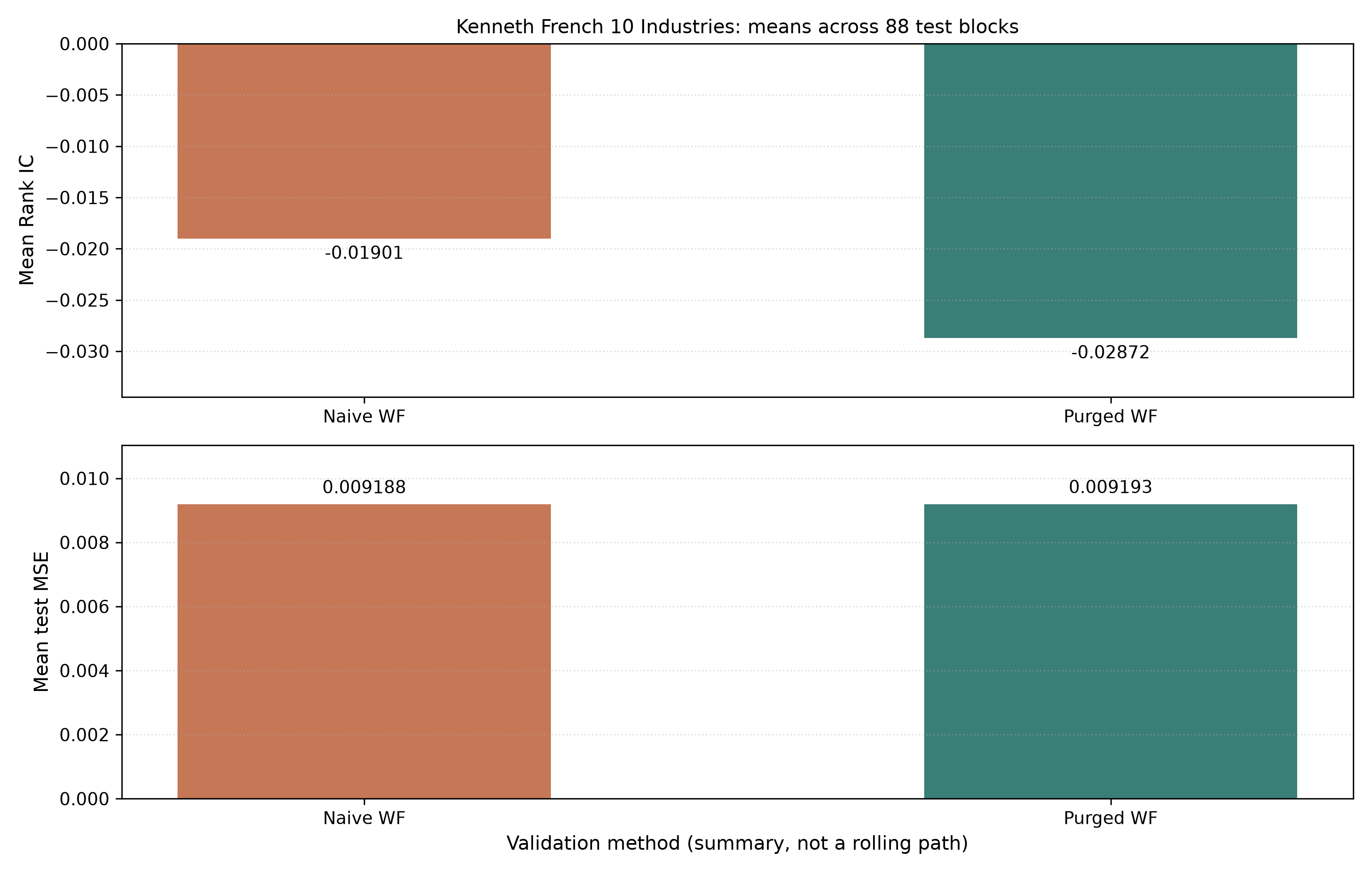
- File path: figures/a6/ch31_french_rolling_validation.png.
- Axes and units: The horizontal axis compares naive and purged validation. The upper panel shows mean Rank IC across 88 test blocks; the lower panel shows mean test MSE. Bar heights show only the saved summary means. They do not show the block-level paths, stability across blocks, or statistical significance of the method difference.
- What to look for:
- With three-month forward overlapping labels, mean test MSE is
for naive Walk-Forward and for Purged Walk-Forward. - On the real academic aggregate industry data, the observed mean Rank IC is
and , respectively. The experiment reports no uncertainty for these means and no significance test, so the negative means do not establish that positive Alpha is absent in the population. The figure reports only the observed results for this dataset, model, and validation window.
- With three-month forward overlapping labels, mean test MSE is
11. Real-Market Example
This section preserves a historical methodological illustration; it is not a newly acquired dataset or rerun. Raw, extracted, and processed French files are absent from the default I3 package, whose Notebook skips this branch. Rights, subjects, and intended uses need separate review. A10-A/A10-A.1 do not replace G05/A10-B execution authorization.
To illustrate model validation on real-market assets, we use the frozen Kenneth R. French 10 Industry Portfolios monthly total-return data in the workspace, covering 1926-07 through 2026-08 (1,202 monthly observations).
11.1 Data Properties and Scope
- Sources: Kenneth R. French Data Library: 10 Industry Portfolios (value-weighted, monthly) and the FF3 risk-free rate (RF).
- Files and hash verification:
- Data manifest: data/manifests/french_industries_2026-10-05.json (SHA-256: 3b71cd5f781f9790cc380195c22635e03e9c9e27a5f43cd2d0d46fb12efa8271).
- Processed return table: data/processed/french_10_industries_monthly.csv (SHA-256: 3b097d810c295d64eedfa1ece7067ff2a0707f5ca90e33935df9949251f70950).
- Academic-use and tradability boundaries: These data are academic aggregate portfolios, have been revised historically, and are not point-in-time snapshots (is_point_in_time: false). They also do not represent the tradable liquidity of individual securities. This example therefore supports methodological instruction only and does not make a live-trading Alpha claim.
11.2 Design: Three-Month Overlapping Forward Returns and Rolling Validation
-
Prediction target: Three-month compounded forward return (
): -
Feature engineering:
- 12-month trailing momentum:
. - One-month short-term reversal:
.
- 12-month trailing momentum:
-
Rolling Walk-Forward windows:
- Fixed training window: 120 months (10 years).
- Test block: 12 months (1 year).
- Step size: 12 months (annual tuning).
- The full sample produces 88 non-overlapping 12-month calendar test blocks. Forward labels can still overlap across blocks, so the blocks are not necessarily statistically independent (key:
french_market_experiment.eval_blocks).
-
Protocol comparison:
- Naive Walk-Forward: The training set consists of the 120 months immediately before each test block, with no Purge. The return intervals for the final two training labels,
and , extend into the first two months of the test block. - Purged Walk-Forward: Purge removes the two months at the end of the training set whose return intervals overlap the test set.
- Naive Walk-Forward: The training set consists of the 120 months immediately before each test block, with no Purge. The return intervals for the final two training labels,
11.3 Observed Results and Reconciliation
The table reports CLI results preserved in an earlier independent review; they were not rerun for this revision (build/codex_a6/final_learning_review/ch31/recheck/results/ch31_results.json):
| Validation scheme | Mean out-of-sample MSE | Mean out-of-sample Rank IC | Evaluation blocks | Lookahead status |
|---|---|---|---|---|
| Naive Walk-Forward (unpurged) | 88 | Return labels from the final two training months overlap | ||
| Purged Walk-Forward | 88 | Overlapping labels are removed |
Interpretation:
- With a 120-month training sample and only two months of overlap (1.67% of the training window), the out-of-sample MSE values are very close:
versus . - The mean out-of-sample Rank IC is slightly negative for both schemes in this split (
and ). The table provides no standard errors, confidence intervals, or test. It supports reporting these sample means only; it does not establish that the population relationship is negative, statistically insignificant, or devoid of Alpha. These academic aggregate portfolios also do not support a tradability conclusion.
12. Common Mistakes
12.1 Mistake 1: Using Randomly Shuffled K-Fold as the Default for Financial Time Series
- Incorrect example and why it fails: This ignores time order and the label-dependence window. After shuffling, adjacent samples can appear in both the training and test sets. When their label windows share information, the test score may be optimistic; the magnitude depends on the data-generating process, features, model, and split. The code below is a fixed synthetic counterexample and does not establish a general bias magnitude.
- Runnable comparison code:
import numpy as np
from sklearn.linear_model import Ridge
from sklearn.model_selection import KFold
from quant_course.validation import walk_forward_splits

rng = np.random.RandomState(42)
N, h = 100, 5
X_all = rng.randn(N + h - 1, 2)
X = X_all[:N]
# period_returns[k] belongs to (k,k+1], so y[i] settles at i+h.
period_returns = 0.6 * X_all[:, 0] + rng.normal(0, 0.2, len(X_all))
y = np.array([period_returns[i:i+h].sum() for i in range(N)])
t = np.arange(N, dtype=float)
e = t + h
a = e.copy()
kf = KFold(n_splits=5, shuffle=True, random_state=42)
scores_leaky = [Ridge().fit(X[tr], y[tr]).score(X[te], y[te]) for tr, te in kf.split(X)]
splits = walk_forward_splits(N, 50, 10, step=10, t=t, e=e)
scores_forward = []
for tr, te in splits:
    tr = tr[a[tr] <= t[te].min()]
    assert np.all(e[tr] <= t[te].min())
    scores_forward.append(Ridge().fit(X[tr], y[tr]).score(X[te], y[te]))
assert np.isfinite(scores_leaky).all() and np.isfinite(scores_forward).all()
print("Shuffled / forward:", np.mean(scores_leaky), np.mean(scores_forward))
The old centered convolution, convolve(X, ones(5)/5, mode="same"), depends on
- Observed score differences: In the five-seed synthetic panel study, the four schemes had the following results:
- Shuffled K-Fold: mean
(Rank IC ). - Naive TSS (gap=0):
(Rank IC ). - TSS (gap=4, global normalization):
(Rank IC ). - Causal Purged Walk-Forward:
(Rank IC ). In this linear Ridge construction, the difference between Shuffled K-Fold and Purged Walk-Forward is . The observed difference between the first two protocols is , and the difference between TSS and the final protocol is about . Because the training/test blocks, samples, and preprocessing all differ, these values do not support a one-factor causal decomposition. In a separate 1-NN construction, the mean Rank IC was without Purge and with Purge (a difference of ). These are simulation results under their respective designs, not general laws about model capacity, leakage, or bias magnitude.
- Shuffled K-Fold: mean
12.2 Mistake 2: Treating TimeSeriesSplit's gap as a Number of Days in a Multi-Asset Panel
- Incorrect example: On a daily panel of 20 stocks, a researcher predicts five-day forward returns and assumes that TimeSeriesSplit(gap=4) removes four days.
- Why it fails: TimeSeriesSplit's gap parameter counts sample rows, not dates. In a 20-stock panel, gap=4 removes only four rows, less than one trading day's records; more than three days of overlapping data remain leaked.
- Fix: Use quant_course.validation.purge to filter explicitly by the trading-date array, or derive indices from unique dates before calling TimeSeriesSplit.
- Numerical difference: In the three-asset example, gap=4 left eight overlapping rows in the training set.
12.3 Mistake 3: Normalizing Features on the Full Sample Before Splitting
- Why it fails: Future test-set means and extreme values are incorporated into the full feature matrix, so the training features use a baseline containing information about the test period's structure.
- Runnable comparison code:
import numpy as np
from sklearn.preprocessing import StandardScaler

rng = np.random.RandomState(42)
X = rng.randn(100, 2) + 2.0

# Incorrect: normalize on the full sample
X_scaled_all = StandardScaler().fit_transform(X)
X_test_leaky = X_scaled_all[80:]

# Correct: fit on the training set only
scaler = StandardScaler()
X_train_clean = scaler.fit_transform(X[:80])
X_test_clean = scaler.transform(X[80:])

# Check that the two transformations differ
assert not np.allclose(X_test_leaky, X_test_clean)
- Observed score difference: Fitting the scaler globally brings test-period distribution information into the training feature baseline. In this small example, the two transformations differ, but the direction of any estimated volatility or mean-drift error is not guaranteed for every sample.
12.4 Mistake 4: Applying Embargo to Training Samples Before the Test Block
- Why it fails: This misunderstands the causal role of Embargo. Embargo guards against backward-looking features reaching into the test labels and is therefore necessary only for training samples located after the test block. Under this chapter's post-test definition, a purely historical forward split has no post-test candidates, so the embargo-removal set is empty. Historical dependency gaps or feature warm-up periods for other purposes are separate constraints; this point does not rule them out.
- Fix: In code, require is_after_test = t_i >= t_test_max and apply the interval filter
only to samples satisfying that condition.
12.5 Mistake 5: Treating Endpoint Touching as Overlap and Removing Too Many Samples
- Incorrect interpretation: A researcher assumes there is overlap when one sample settles at the close on day 6 and the test prediction starts after the close on day 6.
- Economic meaning: The earlier label's return ends at
, while the later label begins at , so the half-open intervals have an empty intersection. Sharing a reference closing price does not mean the price is non-random, nor does it imply that the two returns are statistically independent. The actual order of close settlement, data ingestion, and prediction must still be checked against the event clock; endpoint contact alone does not establish that those events were ordered correctly.
13. Quant Research Application
13.1 End-to-End Validation Pipeline for Quantitative Research
In industry quantitative research, an immutable, leakage-resistant model-validation process is a core safeguard in strategy development. A standard pipeline has four stages:
Stage 1: Freeze the protocol and plan (Ch 22 ResearchPlan)
    - Specify the primary metric (Rank IC), test horizon h, maximum feature lookback m, and asset universe.
Stage 2: Define sample intervals and construct labels (Ch 3, 31)
    - Record each sample's observation time t_i, label end e_i, and availability time a_i.
    - At each prediction time, first filter for a_i <= t_predict; the current helper performs interval Purge using (t_i, e_i) only.
Stage 3: Run the outer causal Walk-Forward (Outer Purged Walk-Forward)
    - Set a historical training window; check a-eligibility and then label overlap. In a purely historical forward split, the post-test Embargo set is empty.
Stage 4: Select hyperparameters in nested inner folds (Inner Nested Selection)
    - Generate subfolds only within the current outer training set; fit normalization only on each inner training set.
13.2 Practical Falsification Rules and Negative Criteria
After building the validation pipeline, a quantitative team should run the following falsification checks:
- Future Invariance Test: With random seeds, identifiers and column schema, and algorithm policy held fixed, apply specified perturbations to valid future inputs and compare model parameters and hyperparameters at shared historical coordinates. Differences beyond the declared tolerance warrant investigation for leakage or nondeterminism. Passing this finite set of tests does not establish validity under every future change or the legality of all input timestamps.
- Shuffling Ablation Check: Compare Purged Walk-Forward with shuffled K-Fold. Similar or reversed scores alone do not establish a lack of temporal dependence or model underfitting; a large difference alone cannot be attributed uniquely to label memorization. First match the evaluation target, training/test dates and sample sizes, and preprocessing. Then investigate distribution and feature support, while preserving results from every protocol.
14. Chapter Summary
14.1 Conceptual Flow
First choose the purpose: historical deployment with available labels, or offline diagnosis with future blocks.
Candidate C -> Does its label overlap?
  Yes -> R_purge: remove the sample and terminate this branch.
  No -> S_after_purge -> Is it post-test and inside the buffer?
    Yes -> R_embargo: remove the sample and terminate this branch.
    No -> S_final -> Scale and select separately within each inner and outer fold.
Neither removal node has an outgoing edge. Only
For a numerical walk-through of the diagram, sample 2 overlaps and enters
14.2 Decision Rules for Validation Schemes
Researchers should choose a validation architecture according to the research question:
| Validation objective and question | Recommended scheme | Purge policy | Embargo policy | Feature-normalization fit range | Main limitation or warning |
|---|---|---|---|---|---|
| Simulate real trading deployment | Expanding or rolling Purged Walk-Forward | Strictly remove the final |
Not needed; all training data precede the test block | Restricted to the current outer training fold | Sample sizes vary over time; early folds have fewer samples |
| Test stability across macroeconomic regimes | Purged K-Fold with contiguous time blocks | Remove overlapping samples on both sides | Apply an |
Restricted to the current outer training fold | Includes future training on past data and cannot replace a deployment test over time |
| Search multiple hyperparameters and select features | Nested Walk-Forward validation | Purge outer and inner folds independently | Apply according to the position of each test block | Fit independently on each outer and inner training set | Computation grows substantially; keep the parameter grid manageable |
| Validate a multi-asset cross-sectional panel | Date-grouped Purged Panel Split | Purge globally by date across assets | Embargo globally by date across assets | Daily cross-sectional normalization or global fit on training data | Do not use row-count gap; filter by trading-date index |
15. Exercises
31-E01: Testing for Overlap Between Half-Open Label Intervals
For one asset's daily data, three samples have the following time parameters:
- Sample A:
. - Sample B:
. - Sample C:
.
Determine:
- Do samples A and B overlap? Give their intersection.
- Do samples A and C overlap? Explain why or why not.
31-E02: Purge Sample Count on a Regular Single-Asset Calendar
A single-asset trading calendar is continuous and has no missing observations. The forecast holding period is
31-E03: Why Embargo Is Not Needed in a Purely Forward Split
Why does a purely forward Walk-Forward split, in which every training sample occurs before the test block, require Purge but no Embargo? Prove this from the perspective of causal information flow and the mathematics of feature lookback windows.
31-E04: Availability Later Than Label Settlement
A factor label is based on a listed company's quarterly return on equity (ROE). Assume the fiscal quarter ends at
If the model prediction time is
31-N01: Find the “Resurrected Sample” in the Flowchart (New)
Someone connects “overlap → remove by Purge” to “not post-test → retain,” then adds the retained item to the final training set. Use sample 2 to explain the error and write the four correct sets with their containment relationships. Explain why samples 1 and 13, which both touch endpoints, have different final outcomes. If the deployment time is 6 and sample 1 has
16. Programming Exercises
31-P01: Implement a Half-Open Interval Intersection Test
Write a function is_overlapping(t1: float, e1: float, t2: float, e2: float) -> bool and verify that it:
- Raises
ValueErrorwhen an input has. - Correctly returns whether the half-open intervals
and intersect. - Returns
Falsefor the endpoint-touching pairand .
31-P02: Implement Purge for a Cross-Sectional Panel
Write a function panel_purge(train_dates: np.ndarray, test_dates: np.ndarray, h: int) -> np.ndarray. The inputs are row-date arrays from a five-asset panel, with multiple rows on the same date. The test set contains samples from specified dates. Return the row indices retained in the training set after Purge, and assert that no observations on overlapping dates remain.
31-P03: Demonstrate the Failure of scikit-learn TimeSeriesSplit gap
Write a standalone Python script that constructs a synthetic panel with three assets over 15 trading days, uses labels with TimeSeriesSplit(gap=4), calculate the number of overlapping rows left in training exactly, and verify whether it is exactly eight.
31-P04: Implement a Strictly Leakage-Resistant Nested Evaluator
Using sklearn.linear_model.Ridge, implement a hyperparameter selector with two outer causal forward folds and two inner validation folds. Fit feature-scaling parameters only on the inner training set, and report the uncontaminated mean squared error on the outer test sets.
17. Challenge Problems
31-C01: Purge Interval Algebra for Irregular Calendars and Suspended Assets (Open Derivation)
In real A-share or Hong Kong markets, an asset may be suspended for several weeks, or different assets may use different delivery and settlement calendars.
- Formally define label intervals that incorporate each asset's individual suspension calendar.
- Prove that, on an irregular calendar, the simplified addition
based on trading-day index can cause local lookahead or over-purge. - Propose a rubric for designing a robust Purge engine aligned by actual calendar days or tradable tick timestamps.
31-C02: A Counterexample to Purged K-Fold Under a Nonstationary Regime Shift (Theory and Numbers)
Construct a two-stage Markov regime-switching data-generating process, such as a low-volatility bull market followed by a high-volatility bear market.
Show that even if Purged K-Fold completely removes overlapping labels and feature-embargo leakage, training on future bear-market data while testing a historical bull-market interval can still make the model parameters differ substantially from the parameters best for the historical regime. Give quantitative evidence and recommendations.
31-C03: Purged Validation Gates Combined with a Multiple-Testing Trial Ledger (Integrated Design)
Combine the TrialLedger from Chapter 22 with the future-perturbation test from Chapter 30 to design an integrated quantitative strategy-admission verification protocol. The protocol must record the Purged splits used to evaluate every hyperparameter variant, account for the number of effective independent trials, and retain a final holdout-test safeguard.
31-C04: Extending Validation to Continuous Labels and Event-Driven Triple-Barrier Labels
Financial applications often use take-profit, stop-loss, and time-expiry triple-barrier labels, in which the label end time
Derive and prove that, under triple-barrier labeling, each sample's
18. Solutions and Solution Hints
31-E01 Solution
- Samples A and B:
- Sample A has interval
, and sample B has interval . - For the overlap test,
and . - Since
, the samples overlap. - Their intersection is
.
- Sample A has interval
- Samples A and C:
- Sample A has interval
, and sample C has interval . - The overlap test gives
and . - The condition
does not hold, because is false. The samples do not overlap. - Economically, sample A's return settles at the close on day 6, while sample C's return starts after the close on day 6. They touch at one endpoint on the time axis but share no holding-period return.
- Sample A has interval
31-E02 Solution
-
As derived in §6.2, when the test block starts at
, its first sample has interval . -
A historical training sample at
has interval . -
The necessary and sufficient condition for overlap with the test set is
. -
Since
, the exact range of historical training indices removed by Purge is: -
The total removed is
samples.
31-E03 Solution
- Proof:
- Embargo is defined to prevent the feature lookback window of post-test training samples from reaching into the test set's realized-return label intervals.
- In a purely forward Walk-Forward split, every training sample satisfies
. - When historical training features are calculated from technical indicators or rolling features, they use information from earlier times, at indices
. They lie entirely before the test set. - Historical training features therefore cannot, in the causal time order, reach into the future test interval.
- Thus a purely forward training set has no feature-lookback penetration risk. Purge is still needed to remove label overlap at the end of the training set, but Embargo is not needed.
31-E04 Solution
- Decision: This sample must not enter the current training set.
- Reason and bias:
- Although the operating period reflected by the financial statement ended at
, at the model decision time the stipulated actual availability time is April 30 at 10:00. The statement is not yet readable on April 15 at 15:00. If only the statutory latest filing deadline were known, without the actual publication and ingestion time, that would not establish whether the information was unknown on April 15; the actual timestamp would need to be checked. - Treating the sample as known training data on April 15 would fit model parameters using information that had not yet been disclosed, creating classic look-ahead bias.
- The correct condition for a sample to enter training is the availability-time constraint
.
- Although the operating period reflected by the financial statement ended at
31-N01 Full Solution (New)
The interval
The return set for sample 1 ends at
31-P01 Reference Implementation
def is_overlapping(t1: float, e1: float, t2: float, e2: float) -> bool:
    if e1 <= t1 or e2 <= t2:
        raise ValueError("Label end e must be strictly greater than observation time t")
    return max(t1, t2) < min(e1, e2)

# Test assertions
assert is_overlapping(2, 7, 6, 11) is True
assert is_overlapping(1, 6, 6, 11) is False  # Endpoint touching is not overlap
assert is_overlapping(0, 5, 6, 11) is False
31-P02 Reference Implementation
import numpy as np
from quant_course.validation import purge

def panel_purge(train_dates: np.ndarray, test_dates: np.ndarray, h: int) -> np.ndarray:
    # Dates are common integer observation positions, not datetime strings.
    if isinstance(h, bool) or h < 1 or int(h) != h:
        raise ValueError("h must be a positive integer observation horizon")
    e_train = train_dates + float(h)
    e_test = test_dates + float(h)
    cand_idx = np.arange(len(train_dates))
    test_idx = np.arange(len(test_dates))
    # Concatenate the full sample for the standard purge
    all_t = np.concatenate([train_dates, test_dates])
    all_e = np.concatenate([e_train, e_test])
    test_offset_idx = np.arange(len(train_dates), len(all_t))
    purged = purge(cand_idx, test_offset_idx, all_t, all_e)
    return purged

# Verification
dates_tr = np.repeat(np.arange(6), 5)  # Five assets on every date 0..5.
dates_te = np.repeat(np.array([6, 7, 8]), 5)
kept = panel_purge(dates_tr, dates_te, h=5)
assert np.array_equal(kept, np.arange(10))  # dates 0 and 1: all ten rows
assert not np.any(np.maximum(dates_tr[kept, None], dates_te[None, :]) <
                  np.minimum(dates_tr[kept, None] + 5, dates_te[None, :] + 5))
31-P03 Reference Implementation
import numpy as np
from sklearn.model_selection import TimeSeriesSplit

dates = np.repeat(np.arange(15), 3)  # 45 rows
test_idx = np.arange(18, 27)         # dates 6..8, 9 rows total
tss = TimeSeriesSplit(n_splits=3, test_size=9, gap=4)
train_tss, test_tss = next(tss.split(np.arange(45)))
assert np.array_equal(test_tss, test_idx)  # Full 45-row sample: first test rows 18..26
assert np.array_equal(train_tss, np.arange(14))
e = dates + 5
overlapping_rows = [i for i in train_tss if any(
    max(dates[i], dates[j]) < min(e[i], e[j]) for j in test_tss)]
assert overlapping_rows == list(range(6, 14))
print("Overlapping rows left in training:", len(overlapping_rows))
assert len(overlapping_rows) == 8
31-P04 Reference Implementation
The forward array period_returns[i] represents the return over
import numpy as np
from sklearn.linear_model import Ridge
from quant_course.validation import nested_hyperparameter_evaluation

rng = np.random.RandomState(123)
N = 100
X_all = rng.randn(N + 1, 2)
X = X_all[:-1]
period_returns = 1.2 * X_all[:, 0] + rng.randn(N + 1) * 0.2
y = period_returns[:-1] + period_returns[1:]
t = np.arange(N, dtype=float)
e = t + 2.0
a = e.copy()  # Availability equals interval end in this example.

candidate_splits = [(np.arange(50), np.arange(50, 75)), (np.arange(75), np.arange(75, 100))]
outer_splits = []
for train_idx, val_idx in candidate_splits:
    prediction_time = np.min(t[val_idx])
    outer_splits.append((train_idx[a[train_idx] <= prediction_time], val_idx))
def inner_split(out_tr, t_arr, e_arr):
    n = len(out_tr)
    folds = []
    for start, stop in [(n // 3, 2 * n // 3), (2 * n // 3, n)]:
        in_train = np.arange(start)
        in_val = np.arange(start, stop)
        prediction_time = np.min(t_arr[out_tr[in_val]])
        in_train = in_train[a[out_tr[in_train]] <= prediction_time]
        folds.append((in_train, in_val))
    return folds

res = nested_hyperparameter_evaluation(
    X, y, t, e, outer_splits, inner_split,
    [{"alpha": 0.1}, {"alpha": 10.0}],
    lambda p: Ridge(alpha=p["alpha"]),
    lambda m, Xt, yt: -float(np.mean((m.predict(Xt) - yt) ** 2)),
    scale_features=True
)
assert len(res["outer_scores"]) == 2
assert all(len(folds) == 2 for folds in res["inner_splits_used"])
for folds in res["inner_splits_used"]:
    for fold in folds:
        tr = np.array(fold["train_idx"]); va = np.array(fold["val_idx"])
        assert tr.size and va.size and t[tr].max() < t[va].min()
        assert np.all(a[tr] <= t[va].min())
        assert not np.any(np.maximum(t[tr, None], t[None, va]) <
                          np.minimum(e[tr, None], e[None, va]))
print("Outer MSE:", [-s for s in res["outer_scores"]])
print("Purged outer splits:", res["outer_splits_used"])
print("Purged inner splits:", res["inner_splits_used"])
31-C01 Full Reference Answer: Irregular Calendars
First state the economic target. This problem defines settlement as the next two valid price observations for that asset, not the next two calendar days. A real study could instead use a fixed common-calendar horizon; those are different labels and should not be treated as interchangeable. Let
Thus A and the test interval share
For precise Purge, use the actual end time
This is the requirement that it not overlap any test sample, rather than a check against an arbitrary representative date. If a single conservative endpoint is required, take
31-C02 Full Reference Answer: Purging Does Not Remove Mechanism Changes
First define a two-state Markov chain with
Sample
For a bidirectional K-Fold test on B0, train on B1 and B2. The training-label mean is
The point is that interval purging removes information sharing caused by intersecting label windows; it does not make future training data available in the past or ensure identical distributions across blocks. Bidirectional Purged K-Fold can be used as a clearly bounded historical-regime diagnostic. Deployment evaluation requires forward training, filtering by actual availability times, and checking sensitivity to regime changes and windows. Forward validation also cannot guarantee a stable future distribution. This is not a formal definition of a “conditional-variance tester,” and passing Purge does not prove that every form of information leakage has been eliminated.
31-C03 Full Reference Answer: Trial Ledgers and Admission Gates
Do not arbitrarily reduce the number of trials used for FWER correction based on feature correlation or spectral effective dimension. Retain every attempt in the Chapter 22 ledger. If an effective-trial approximation is used, separately construct the null distribution of the search statistic and state the dependence assumptions it requires; otherwise apply conservative Bonferroni or Holm correction to the full family. The Chapter 30 Z versus −Z counterexample shows that dimension 1 does not mean that only one trial was attempted.
Freeze the three specifications in the same hypothesis family, along with the primary metric, label horizon, Purge rule, sample window, and test method. Record every attempt whose result has been inspected. Suppose the three valid individual p-values are
For Holm, sort the p-values in ascending order and compare them successively with
Select the primary specification using only the discovery period and inner training validation; do not use the outer test for selection. Set economic thresholds, such as post-cost performance, maximum turnover, and worst-case scenarios, then run a completely unused holdout period once. Report it whether it passes or fails. If the model is changed after inspecting the holdout results, that period has become part of discovery and can no longer be called an untouched test. Passing all three tests also does not prove three tradable Alphas; economic significance, execution costs, capacity, and validation in a new period remain necessary.
31-C04 Full Reference Answer: Event Endpoints and Availability Times
Given profit and loss barriers and a maximum observation horizon
A barrier that is never triggered can be represented by
Do not set every sample's endpoint to the maximum horizon. That would incorrectly extend
19. Further Reading
- Official scikit-learn model-selection documentation (Must Know):
- Read the source implementation of
sklearn.model_selection.TimeSeriesSplitand the time-series-splitting discussion in the official User Guide. - Focus on the difference between how the
gapparameter counts observations in a single time series versus a multi-sample cross-section, and understand its row-count limitation.
- Read the source implementation of
- Extensions to financial cross-validation and information purging (Advanced, not reviewed):
- Marcos López de Prado (2018), Advances in Financial Machine Learning, John Wiley & Sons, Chapter 7, “Cross-Validation in Finance.”
- Status: No print or electronic copy of this book is present in the local workspace, and it has not been reviewed. This is only a further-reading lead; no priority claim is based on a source that has not been reviewed. This chapter presents interval algebra and conditional derivations directly and does not claim to establish an independent universal standard.
- Nested hyperparameter optimization and generalization assessment (Should Know):
- Read a standard machine-learning textbook's derivation of the asymptotic unbiasedness of generalization-error estimates from nested cross-validation.
- Understand how the inner and outer loops must preserve one-way causal flow under time dependence.
20. References
SK_TSS: scikit-learn documentation forsklearn.model_selection.TimeSeriesSplit, version 1.9.1 in the historical 2026-10-07 record. This revision does not claim it is the latest online version. Historical local source inspection confirmedtrain_end = test_start - gapand its row-count-based truncation.SK_PITFALLS: scikit-learn documentation, “Common pitfalls and recommended practices in machine learning validation.” Official guidance on leakage from full-sample preprocessing and feature contamination.PBO: Bailey, D. H., Borwein, J., López de Prado, M., & Zhu, Q. J. (2014). “Pseudo-Mathematics and Financial Charlatanism: The High Probability of Overfitting in Financial Investment.” Notices of the AMS.FRENCH_10_IND: Kenneth R. French Data Library, 10 Industry Portfolios (value-weighted, monthly), 1926-07 through 2026-08 (1,202 months). Manifest file SHA-256:3b71cd5f781f9790cc380195c22635e03e9c9e27a5f43cd2d0d46fb12efa8271.- Chapter code and historical independent-review results, not rerun for this revision:
code/ch31_model_validation.py; numerical output:build/codex_a6/final_learning_review/ch31/recheck/results/ch31_results.json; historical review figures:build/codex_a6/final_learning_review/ch31/recheck/figures/ch31_*.png. Existing historical QA and figures cited in the chapter have not been overwritten.